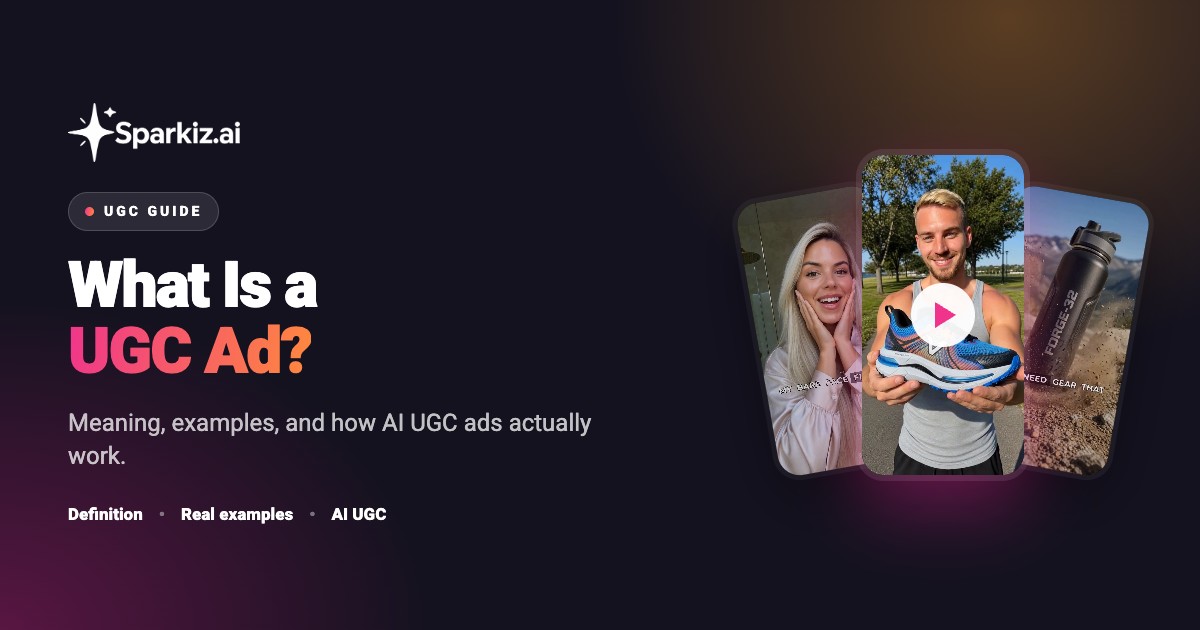
A UGC ad is a paid ad built to look like a video from a real customer, not a brand. It is usually a vertical clip of a person talking to camera while they show, use, or review a product, and a brand pays to run it on TikTok, Instagram, or Facebook. The UGC part is the honest, hand-held style. The ad part is that the brand puts money behind it.
What does UGC stand for?
UGC stands for user-generated content: photos, videos, and reviews made by regular people rather than a brand's studio. A UGC ad takes that same authentic style and runs it as paid media. So "UGC" is the look and feel, and "UGC ad" is that look and feel used as an advert.
What is a UGC ad, exactly?
Here is the distinction most guides blur. Not every piece of UGC is an ad, and not every ad in a creator style is genuine UGC. The line is simple: money and intent.
UGC (the content)
An organic post a customer or creator shares on their own feed. No media spend. The goal is to share an experience.
A UGC ad (paid)
The same style of video, but a brand runs it as a paid ad with a budget and a target audience. The goal is to sell.
A UGC ad also is not an influencer post. With an influencer, a brand pays for that person's audience and reach. With a UGC ad, the brand only wants the content itself, then buys its own reach with ad spend. That difference changes the whole cost model, which we come back to below.
What does a UGC ad look like?
Words only get you so far with a video format. Below is a real UGC-style ad. It was not filmed with a creator or a camera. Sparkiz AI generated it from a single product link, with an AI presenter, a written script, a voiceover, and captions.
A real UGC-style ad, generated by AI from a product link. Tap to play.
UGC ad vs influencer ad vs brand ad
These three get mixed up constantly, yet they behave very differently on price, trust, and control. Here is the honest side-by-side.
| UGC ad | Influencer ad | Brand / studio ad | |
|---|---|---|---|
| What you pay for | The content only | The person's audience | Production polish |
| Feel | Authentic, hand-held | Aspirational | Polished, corporate |
| Where it runs | Your paid ads | The creator's feed | Your paid ads |
| Who has the following | Not needed | Required | Not needed |
| Typical cost | Low per video | High (reach-based) | Highest |
| Best for | Performance ads at scale | Awareness, credibility | Brand campaigns |
Why do UGC ads work?
Buyers scroll past anything that looks like an ad. A UGC ad does not look like one. It looks like a person they might follow, holding a product they might buy. Three things drive the result:
- Trust. A real face and a plain-spoken opinion read as a recommendation, not a pitch.
- Native feel. The clip matches the feed it runs in, so people watch instead of skipping.
- Volume beats polish. You can run many rough, honest angles and let the data pick the winner, instead of betting a big budget on one glossy spot.
What are the main types of UGC ads?
Most winning UGC ads fall into a handful of repeatable formats. Pick the one that fits the product and the objection you need to beat.
- Testimonial: a person explains why the product solved their problem.
- Unboxing: the first-look moment, focused on the reveal and packaging.
- How-to / demo: the product used step by step, so the viewer sees it work.
- Before and after: the outcome shown up front to earn the watch.
- Problem and solution: name a frustration, then show the fix.
Anatomy of a UGC ad
Under the casual surface, a UGC ad that converts follows a tight four-beat structure. The first beat carries most of the weight.

In order, the four beats are a Hook in the first 0–3 seconds (a pattern interrupt that stops the scroll), the Problem (name the exact pain the viewer feels), the Product (shown solving it with a quick, believable demo), and the CTA (one clear next step, said the way a friend would).
What is AI UGC?
AI UGC means UGC-style ads generated by software instead of filmed with a creator. An AI tool writes the script, picks an AI presenter, produces the voiceover, adds captions, and outputs a finished video. It is the same authentic format, made without a shoot.
Where AI UGC wins: speed and cost. You can produce many hook variations in minutes for a few dollars each, which turns testing from an expensive gamble into a routine. Where a real creator still wins: a specific personal story, a face your audience already knows, or a niche only a human has lived. Most brands now use both, and lean on AI to test broadly before spending on a bespoke creator.
In practice, an AI UGC ad is made in a few minutes: you give the tool a product link or details, and it returns a ready-to-post MP4. If you want the full walkthrough, see how to make UGC ads, or start on the AI UGC generator.
The full 2-minute walkthrough, from a product link to a finished UGC ad. Tap to play.
See what a UGC ad looks like for your product
Paste a product link and get a finished, ready-to-post ad. Your first one is $3.
Create an AI ad →UGC ad FAQ
Do UGC creators get paid?
Yes. A UGC creator is paid a flat fee to produce the video, whether or not they have a following. They usually do not earn from reach, because the brand runs the clip through its own paid ads.
Are UGC ads legal? Do they need disclosure?
They are legal. If a creator was paid or given free product, that connection should be disclosed under FTC and platform rules. For AI UGC, follow each platform's policy on AI-generated and synthetic media, and avoid implying a real person endorsed something they did not.
Can you make UGC ads for free?
You can gather organic UGC for free by resharing genuine customer posts (with permission). Running it as a paid ad still costs media spend. AI UGC tools let you generate ads from as little as a few dollars per video.
How much do UGC ads cost?
Human UGC creators typically charge from about $50 to $500 per video, and more once you add usage rights. AI UGC costs a few dollars per video. Full breakdown in how much UGC ads cost.
The Sparkiz AI team writes about video advertising, UGC, and creating ads that convert, to help brands produce winning creative fast and affordably.
More from the blog →